How Apple Fits Hundreds of Expert AI Models on Your Phone
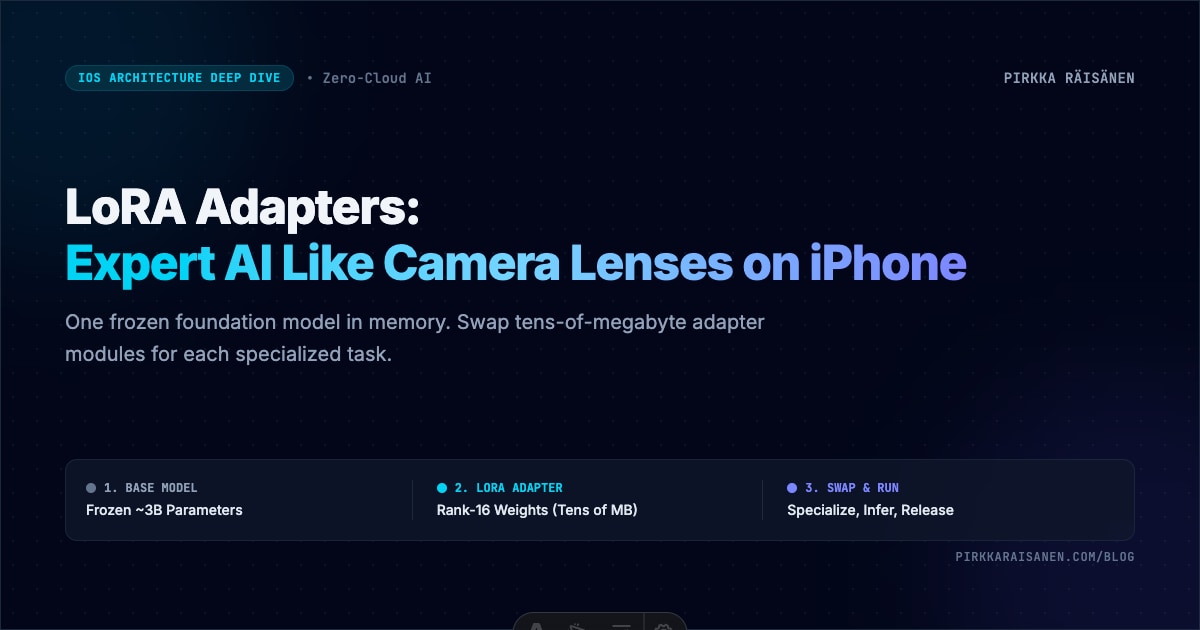
Apple uses LoRA adapters to run specialized AI tasks on iOS. By swapping tens-of-megabyte weight modules like camera lenses, one base model serves many experts without exhausting storage.
Apple uses LoRA adapters to run specialized AI tasks locally on your device. The system keeps one frozen foundation model in memory and swaps small adapter weight files in and out, like swapping lenses on a single camera body. Multiple expert models share one base without exhausting iPhone storage or RAM. As an engineer building on-device Apple Foundation Models, this modular adapter approach is how I ship specialized features without bloating app bundles.
Apple’s on-device foundation model is roughly 3 billion parameters. It needs gigabytes of storage and active RAM. If developers shipped a separate full model for summarization, code generation, and notification sorting, storage balloons and iOS terminates the processes to protect system memory. Apple decoupled the reasoning engine from task-specific expertise.
The Storage Bottleneck
A large language model learns general logic during initial training. Fine-tuning for a specific task, like drafting emails, can update billions of weights across the network.
Save a new full model copy for every task and a 4 GB base file becomes 40 GB for ten tasks. That architecture does not scale on mobile hardware.
The Camera Lens Analogy
Apple engineers bypassed the bottleneck with Low-Rank Adaptation (LoRA). Compare it to professional photography.
A photographer shooting a landscape and then a macro portrait does not buy two camera bodies. They keep one body and swap the lens.
In Apple’s AI stack, the camera body is the frozen ~3B-parameter foundation model loaded in memory. The lenses are LoRA adapters: small weight modules fine-tuned for specific tasks.
How Apple LoRA Adapters Work on iPhone
LoRA freezes the base weights and injects trainable low-rank matrices into transformer layers instead of retraining the full network.
Apple’s foundation models research stores adapter parameters in 16-bit precision. For the on-device model, a rank-16 adapter typically requires tens of megabytes. Apple reports rank 16 as the optimal tradeoff between capacity and inference performance, with ranks 8, 16, and 32 available for different use cases.
Those adapters can be dynamically loaded, temporarily cached, and swapped so the base model specializes on the fly while the OS manages memory and responsiveness.
When iOS routes a user request, the system attaches the matching adapter to the frozen base model, runs inference on the Neural Engine, then releases the adapter. One base model serves many functions without duplicating gigabytes of weights per task.
Developers can train custom adapters with Apple’s Foundation Models adapter toolkit and ship them through the Foundation Models framework in Swift.
The Independent Developer Advantage
When expertise lives in megabyte-scale adapters, application architecture changes. You do not need a multi-gigabyte LLM inside your App Store bundle or a recurring per-token cloud API bill.
You can target the on-device foundation model already on the user’s phone and ship a small adapter tuned to your app’s domain.
I build LocalPlan and LocalMemo on on-device Apple Foundation Models. Inference runs on local silicon; latency stays low and your data never leaves the device.
Conclusion
LoRA adapters treat AI expertise as a modular plugin, not a monolithic build. Swap megabyte-scale files on demand and the storage bottleneck shrinks. If you build for iOS, serving custom adapters on Apple’s base model is the efficient deployment path.
Try LocalPlan, LocalMemo, or Kaari to see on-device inference in production. Explore the App Catalog for more on-device apps and architecture notes.
Sources: Apple Foundation Models · Apple Intelligence Foundation Language Models (arXiv) · Foundation Models adapter training
Self-Test & FAQ
Click to reveal answerWhat is a LoRA adapter?
Why compare AI adapters to camera lenses?
How fast do these adapters load on iOS?

Newsletter
Join the Newsletter
Technical notes on on-device AI, generative music workflows, and building native Apple software sent directly to your inbox.
Subscribe via beehiiv. See ourPrivacy Policy.