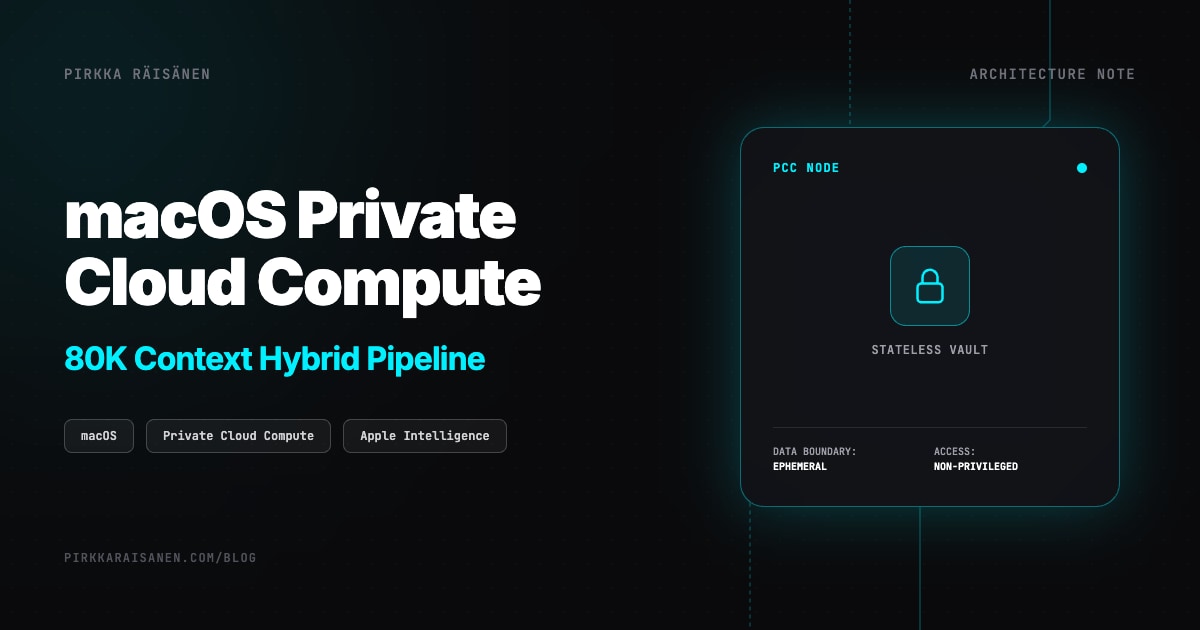
How macOS Private Cloud Compute Solves the On-Device AI Context Barrier
Apple's Private Cloud Compute brings server-class reasoning to macOS while preserving local-first privacy. Hybrid fallback architecture powers modern Mac applications.
Watch the original short →Featured application
Apple uses Private Cloud Compute (PCC) to solve the context window barrier on macOS while preserving strict local-first privacy guarantees. By providing stateless, server-side execution for complex prompts, the system brings frontier-scale reasoning to native Mac apps. As an independent developer building privacy-first Mac software, I use this hybrid routing to power CoreRecord.
Historically, processing massive intelligence workloads like analyzing an 80,000-character meeting transcript belonged to heavy cloud infrastructure. That scale demands server-class hardware and massive memory bandwidth. Apple expanded its on-device foundation model strategy into a hybrid pipeline to unlock frontier-scale capabilities while maintaining verifiable transparency.
The Memory and Privacy Dilemma
In an on-device-only execution model, the Mac’s unified memory targets real-time responsiveness. Scaling intelligence to process multi-hour context windows requires moving the heaviest compute loads off local silicon so the desktop stays fluid under load.
To preserve the guarantees of a local-first application, the architecture must give users control over their data with zero off-device retention.
The High-Security Offsite Vault Analogy
Apple engineers treat Private Cloud Compute like a high-security offsite vault, not a shared public data center.
In standard cloud computing, the facility keeps copies of your data, and the staff holds master keys to debug the system. Private Cloud Compute operates like a secure courier. When a heavy prompt arrives, your Mac encrypts the prompt and transmits it to the vault. The vault processes the request, returns the generated response, and erases all records of the transaction. There is zero privileged runtime access. User data stays isolated and inaccessible during execution.
Verifiable transparency is Apple’s cryptographic technique behind this offsite security model.
How Private Cloud Compute Works in Practice
macOS decouples model reasoning from the local machine’s physical hardware footprint through the Foundation Models framework.
At inference time, the application evaluates the context using ContextOptions and invokes PrivateCloudComputeLanguageModel for deep reasoning tasks. Because cloud network availability fluctuates and daily quotas exist, building a hybrid fallback pipeline ensures continuous availability. If the secure cloud connection drops, the app routes the request back to the local SystemLanguageModel so processing does not halt.
Apple enforces strict architectural data boundaries:
- Local Audio Capture: Raw audio files and real-time audio streams never leave the local hard drive.
- On-Device Speech Processing: Live transcription runs on local Apple Silicon cores.
- Stateless Summarization: Only sanitized, timestamped transcript text is sent via the cryptographic PCC pipeline when deep executive summaries are requested.
You get frontier-scale reasoning on a massive 80,000-character context window while the device stays cool under load. Hybrid intelligence elasticity means compute scales to the cloud when the prompt needs it, inside an environment built on non-targetability and verifiable security guarantees.
The Architectural Advantage
Private Cloud Compute expands what native desktop applications can achieve. Heavy workloads like complex semantic extraction and executive summaries can leverage server-scale compute while preserving local privacy guarantees.
In CoreRecord, this hybrid architecture lets users capture local microphone and system audio. Compute scales with meeting length while raw recordings stay on local hardware.
Conclusion
Private Cloud Compute offloads the heaviest inference to Apple’s stateless cloud while the Mac keeps capture, storage, and keys local. Large context and executive summaries no longer require treating a public cloud like shared storage. Hybrid PCC routing keeps native apps working when the link or quota fails, without giving up a local-first privacy boundary.
Try CoreRecord to see hybrid PCC architecture in production. Explore the App Catalog for more on-device apps and architecture notes.
Sources: Private Cloud Compute Security Guide · Foundation Models Framework
Self-Test & FAQ
Click to reveal answerWhat is Apple Private Cloud Compute?
How does Private Cloud Compute guarantee privacy?
What happens if Private Cloud Compute goes offline?

Newsletter
Join the Newsletter
Technical notes on on-device AI, generative music workflows, and building native Apple software sent directly to your inbox.
Subscribe via beehiiv. See ourPrivacy Policy.